For laboratory research use only. Not for human consumption.

For laboratory research use only. Not for human consumption.
Welcome back! Please enter your details.
Aminos
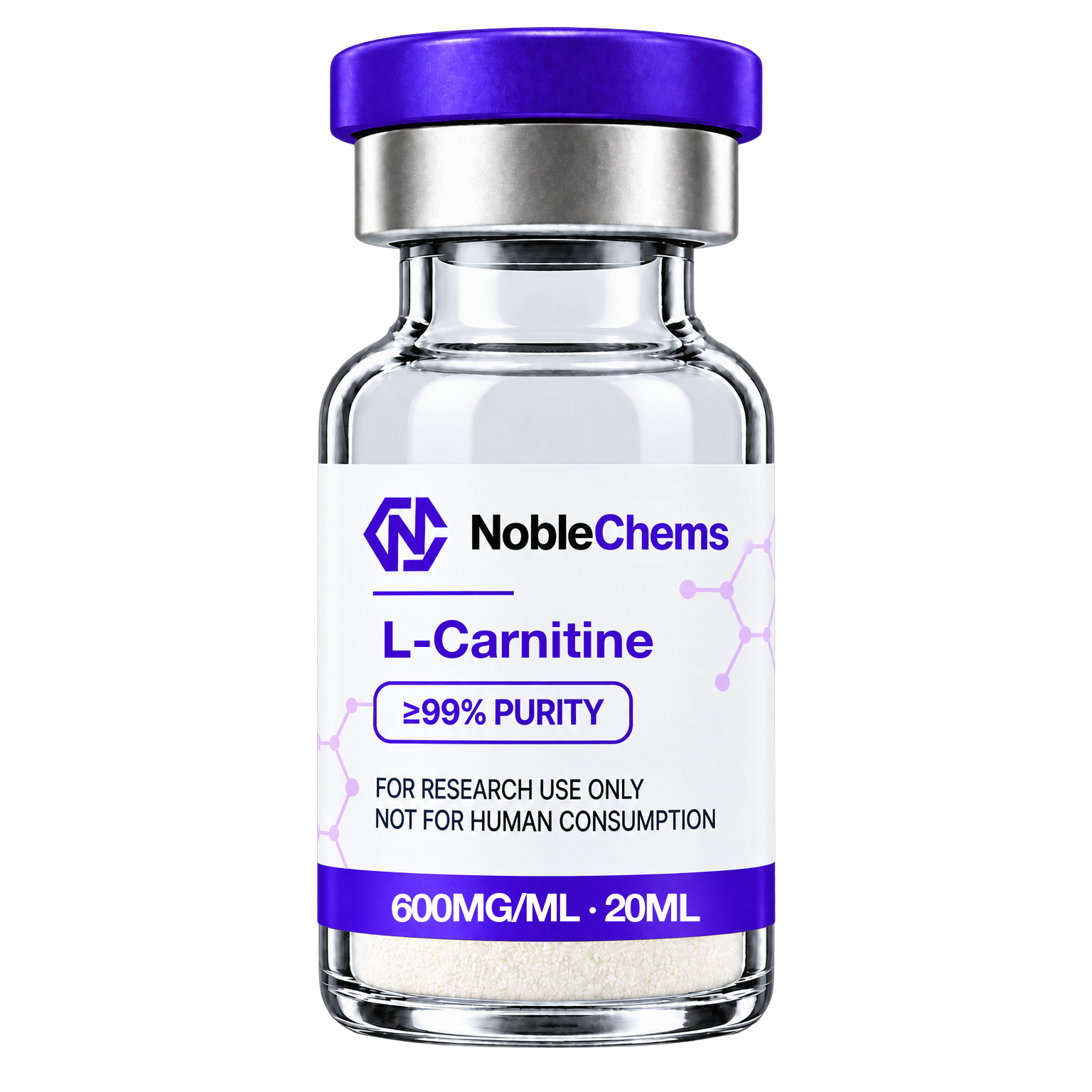
L-Carnitine (4-trimethylammonio-3-hydroxybutyrate) is an essential zwitterionic quaternary ammonium compound and obligate cofactor for mitochondrial fatty acid beta-oxidation. Functioning as a primary substrate for carnitine palmitoyltransferase enzymes (CPT-1 and CPT-2), L-Carnitine translocates long-chain fatty acyl-CoA esters across the inner mitochondrial membrane into the matrix for Krebs cycle ATP generation while buffering intracellular acetyl-CoA/free CoA ratios.
In Stock
Secure Checkout
Encrypted & Safe
Batch Tested
Verified Quality
Fast Shipping
Discreet Delivery
| Quantity | Price / Unit | You Saved |
|---|---|---|
| 1 – 3 | $51.00 | — |
| 4 – 6 | $47.02 | 7.8% |
| 7 – 9 | $43.81 | 14.1% |
| 10+ | $39.07 | 23.4% |
Price breaks are applied automatically in cart.
$43.20
$8.00
$42.00
L-Carnitine (known chemically as 4-trimethylammonio-3-hydroxybutyrate or (R)-(3-carboxy-2-hydroxypropyl)trimethylammonium hydroxide) is an endogenous amino acid derivative synthesized from L-lysine and L-methionine. Operating as an indispensable metabolic cofactor, L-Carnitine regulates mitochondrial energy production by mediating the transport of activated long-chain fatty acids across the impermeable inner mitochondrial membrane.
By forming transient acylcarnitine esters via carnitine palmitoyltransferase 1 (CPT-1) and carnitine palmitoyltransferase 2 (CPT-2), L-Carnitine supplies long-chain fatty acyl-CoA molecules directly to the mitochondrial matrix for mitochondrial beta-oxidation. Concurrently, it buffers excess matrix acetyl-CoA via carnitine acetyltransferase (CRAT), preventing metabolic feedback inhibition of the Pyruvate Dehydrogenase (PDH) complex.
Batch-verified for high analytical purity at NobleChems, L-Carnitine is supplied in a high-concentration 600mg/mL pre-mixed liquid solution packaged in a 20mL sterile glass vial. Researchers evaluating mitochondrial respiratory capacity, fatty acid oxidation flux, and cellular energy expenditure utilize L-Carnitine alongside complementary metabolic reference standards available on the site, such as SLU-PP-332, BAM15, AICAR, and MOTS-C.
| Compound Name | L-Carnitine (Levocarnitine) |
|---|---|
| Quantity / Formats Offered | 600mg/mL Liquid Solution in 20mL Glass Vial (12,000mg Total Mass) |
| Synonyms / Alt Names | Levocarnitine, (R)-Carnitine, 4-trimethylammonio-3-hydroxybutyrate, L-Carnitine Base |
| CAS Number | 541-15-1 |
| Chemical Formula | C7H15NO3 |
| Molecular Weight | 161.20 g/mol |
| IUPAC Name | (3R)-3-hydroxy-4-(trimethylazaniumyl)butanoate |
| InChIKey | InChIKey=XEEIOWLUKPNEGL-LURJTMSTSA-N |
| SMILES Code | CN+(C)CC@@HO |
The biochemical pathways and cellular targets include:
CPT-1 & CPT-2 Mitochondrial Fatty Acid Shuttle: Long-chain fatty acids cannot cross the inner mitochondrial membrane independently. On the outer membrane, CPT-1 transfers the acyl group from fatty acyl-CoA to L-Carnitine, forming acylcarnitine. After translocating across the membrane via carnitine-acylcarnitine translocase (CACT), CPT-2 regenerates fatty acyl-CoA inside the mitochondrial matrix for immediate beta-oxidation.
Acetyl-CoA / Free CoA Ratio Buffering (CRAT Pathway): During high metabolic rates, rapid glycolysis generates excess mitochondrial acetyl-CoA. It reacts with acetyl-CoA via carnitine acetyltransferase (CRAT) to form acetyl-L-carnitine and free Coenzyme A (CoA). This liberates free CoA to sustain Pyruvate Dehydrogenase (PDH) activity and Krebs cycle turnover.
Mitochondrial Membrane Protection & Lipid Redox Defense: By facilitating the removal of toxic short- and medium-chain acyl groups from cells, L-Carnitine prevents intracellular accumulation of amphiphilic fatty acid intermediates, preserving mitochondrial inner membrane potential (ΔΨm) and reducing reactive oxygen species (ROS) production.
When evaluating research efficacy and published scientific literature:
Carnitine Shuttle Kinetics & Beta-Oxidation (PubMed): Landmark bioenergetic studies cataloged on PubMed (PMID: 21521252) confirm that increasing L-Carnitine cell density upregulates CPT-1 enzyme activity, boosting long-chain fatty acid oxidation rates and ATP production in muscle and hepatic cell models.
Mitochondrial Energetics & PDH Complex Flux (PMC): Comprehensive biomedical reviews archived in PMC (PMC3099008) document its ability to buffer intramitochondrial acetyl-CoA pools, maintaining glucose and pyruvate oxidation capacity during elevated metabolic stress.
Chemical Profiling & Identification (PubChem): Official structural characterization maintained on PubChem verifies the molecular mass (161.20 g/mol), zwitterionic quaternary ammonium structure, and HPLC mass spectrometry profile of CAS 541-15-1.
To evaluate metabolic transport mechanisms, mitochondrial energy pathways, and bioenergetic targets, researchers compare L-Carnitine against alternative reference compounds available at NobleChems:
In laboratory research settings, vehicle density and physical format significantly impact experimental utility:
600mg/mL Pre-Solubilized Liquid Solution (20mL Vial): Provides high active mass density (12,000mg total L-Carnitine per bottle) in a pre-mixed, ultra-pure liquid matrix. This allows precise volumetric micropipetting directly into cell culture media or analytical tissue baths without requiring manual dry-powder mass weighing.
Standard Oral / Dry Powder Formats: Require weighing step preparation and exhibit variable solubility rates in polar solvents depending on ambient humidity, increasing preparation time and potential mass measurement variance during high-throughput screening.
| Compound / Reference | Chemical Structure & Class | Core Mechanism of Action | Research Focus & Profile |
|---|---|---|---|
| L-Carnitine | Zwitterionic Quaternary Ammonium Compound | Translocates long-chain fatty acids into mitochondria via CPT-1/CPT-2 and buffers acetyl-CoA via CRAT | Focuses on mitochondrial beta-oxidation, carnitine shuttle kinetics, fatty acid transport, and systemic metabolic flux |
| Acetyl-L-Carnitine (ALCAR) | Acetylated L-Carnitine Ester Derivative | Crosses blood-brain barrier intact; donates acetyl groups for acetylcholine synthesis and mitochondrial ATP production | Focuses on neuro-energetics, central nervous system lipid transport, acetyl donor signaling, and cognitive bioenergetics |
| SLU-PP-332 | Pan-ERR Nuclear Receptor Agonist | Binds ERRα/β/γ receptors to recruit PGC-1α and upregulate mitochondrial OXPHOS gene transcription | Focuses on nuclear receptor exercise mimetics, oxidative muscle fiber switching, and de novo mitochondrial biogenesis |
| BAM15 | Mitochondrial Protonophore Uncoupler | Uncouples oxidative phosphorylation from ATP synthesis by discharging the mitochondrial inner membrane proton gradient | Focuses on uncoupled respiration, energy expenditure elevation, and lipid oxidation independent of fatty acid shuttles |
Yes, NobleChems is a highly trusted vendor for high-purity research chemicals and reference compounds. Every batch undergoes strict third-party analytical testing (including HPLC and Mass Spectrometry) to verify minimum 98%+ chemical purity, exact 600mg/mL concentration, and complete absence of heavy metals or synthesis impurities.
L-Carnitine (4-trimethylammonio-3-hydroxybutyrate) is a naturally occurring quaternary ammonium compound essential for cellular bioenergetics. It acts as an obligate cofactor for carnitine palmitoyltransferase enzymes, facilitating the transport of long-chain fatty acids across the inner mitochondrial membrane for beta-oxidation and ATP production.
It binds long-chain fatty acyl-CoA molecules via carnitine palmitoyltransferase 1 (CPT-1) on the outer mitochondrial membrane to form acylcarnitine. Acylcarnitine translocates into the mitochondrial matrix via carnitine-acylcarnitine translocase, where CPT-2 regenerates fatty acyl-CoA for Krebs cycle entry.
NobleChems supplies a high-density 600mg/mL pre-solubilized liquid solution packaged in a 20mL sterile glass vial. This format provides high active compound density for precise volumetric addition in cell culture and biochemical assay preparations.
By reacting with excess mitochondrial acetyl-CoA via carnitine acetyltransferase (CRAT), L-Carnitine forms acetyl-L-carnitine and releases free Coenzyme A. This buffer mechanism maintains Pyruvate Dehydrogenase (PDH) complex activity and prevents metabolic feedback inhibition during elevated glycolytic or oxidative flux.
It functions primarily as a fatty acid transport shuttle across mitochondrial membranes. Acetyl-L-Carnitine (ALCAR) contains an acetylated ester group that enables enhanced lipophilicity and blood-brain barrier transport, serving as both a carnitine donor and an acetyl substrate for central neurotransmitter synthesis.
NobleChems utilizes High-Performance Liquid Chromatography (HPLC) to confirm active purity exceeding 98% and Mass Spectrometry (MS) to verify exact molecular weight (161.20 g/mol) and active compound concentration prior to batch release.
20mL glass vials should be stored tightly sealed in a cool, dry environment (15°C to 25°C) protected from direct sunlight, light exposure, and heat. Under controlled room temperature conditions, this solution maintains complete solubility and stability throughout its designated shelf life.
Disclaimer: All compounds and research materials provided by NobleChems are strictly for laboratory and research professional use only. They are not approved for human or animal use nor consumption by the Food and Drug Administration (FDA). These products should not be used for any form of in vivo experimentation or for any other non-laboratory purpose. Any violation or indication of human or animal use will result in immediate removal from being able to purchase products in the future. By purchasing these products, you acknowledge that they will be used exclusively within a controlled and qualified research environment.
All products listed on this site are sold strictly for laboratory research use only. They are not drugs, foods, cosmetics, or medical devices, and must not be misbranded, misused, or mislabelled as such.
Products are not intended for human or veterinary consumption, diagnosis, treatment, or prevention of any condition. Purchasers confirm they are qualified researchers or institutions and accept full responsibility for safe handling, storage, and lawful use.
Every batch is independently tested and its certificate of analysis published against the lot number printed on the vial.

Free Shipping
On orders over $199

24/7 Support
We’re here to help

Independent Testing
Every batch tested

Secure Checkout
Safe & encrypted
STAY UPDATED
Know when something’s back in stock before it sells out, and when new COAs are posted.